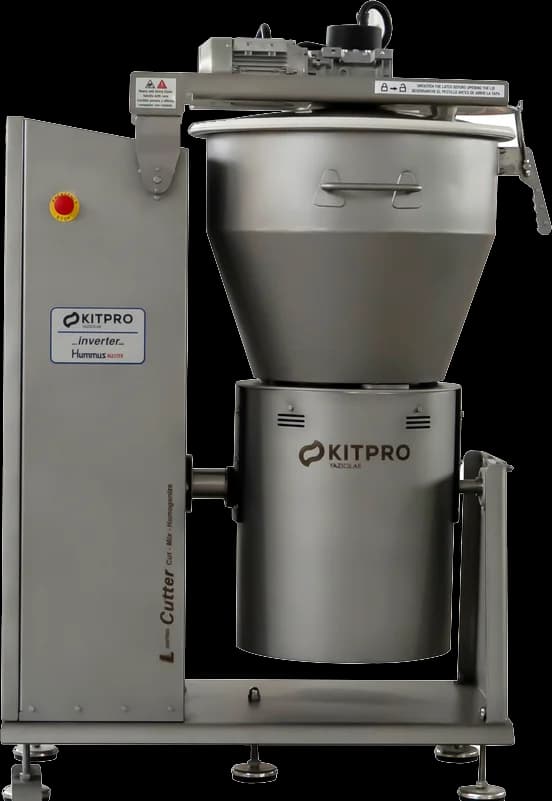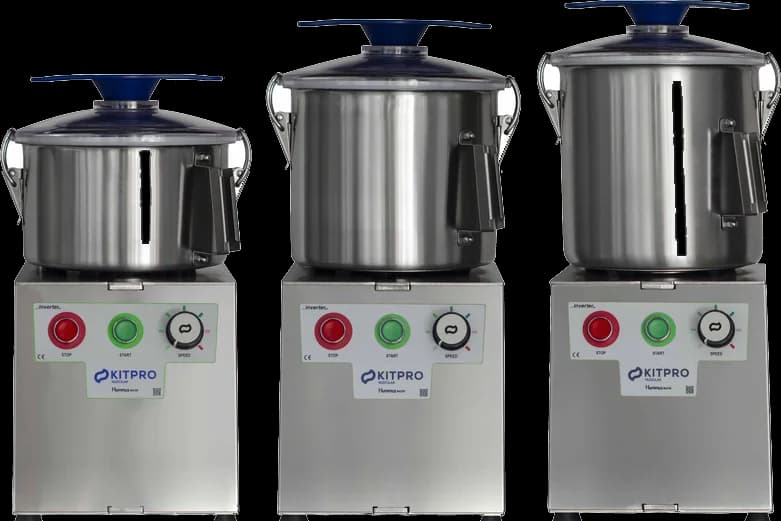

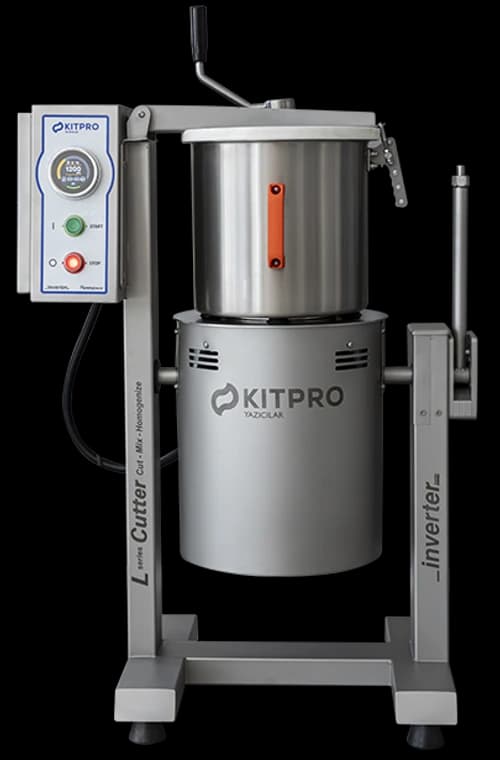
Bowl volume is not batch volume
The litre figure in the catalogue is the geometric volume of the bowl. It is never filled completely: the blade has to be able to throw the material, the mix must not climb the wall and overflow, and the motor must not be overloaded. For dense products (hummus, pastes, tahini) the safe fill ratio is around 65%; for more fluid products it can reach 70%.
That is a direct multiplier in your sizing. A 30-litre bowl handles roughly 19-20 litres per batch, a 65-litre bowl about 42 litres. Size on rated volume and you will overestimate capacity by about a third.
- Dense (paste, tahini, hummus): 60-65% of the bowl
- Medium (sauce, filling, meat emulsion): 65-70%
- Fluid (soup base, purée): 70%
From daily target to bowl volume
Four steps. Take a plant producing 600 kg of hummus a day as the example.
1. Set the shift length. This is the time the machine actually runs. Preparation, cleaning and breaks come off. In an 8-hour shift a machine is typically in production for 6 hours.
2. Measure the batch time. Total time including filling, processing and discharge. Hummus typically runs 8-12 minutes, sauces and pastes 5-8, meat emulsions 6-10. A 10-minute batch means 6 batches an hour.
3. Find the batch volume. 600 kg ÷ (6 hours × 6 batches) = roughly 17 kg per batch.
4. Convert to bowl volume. 17 kg ÷ 0.65 ≈ 26 litres. A 30-litre bowl is the right choice for this production: 20 litres will not keep up, and 45 litres would run half empty.
If your product density differs noticeably from 1 kg/L (tahini around 1.1, aerated fillings below 1), apply that figure when converting kilograms to litres.
Capacity tiers
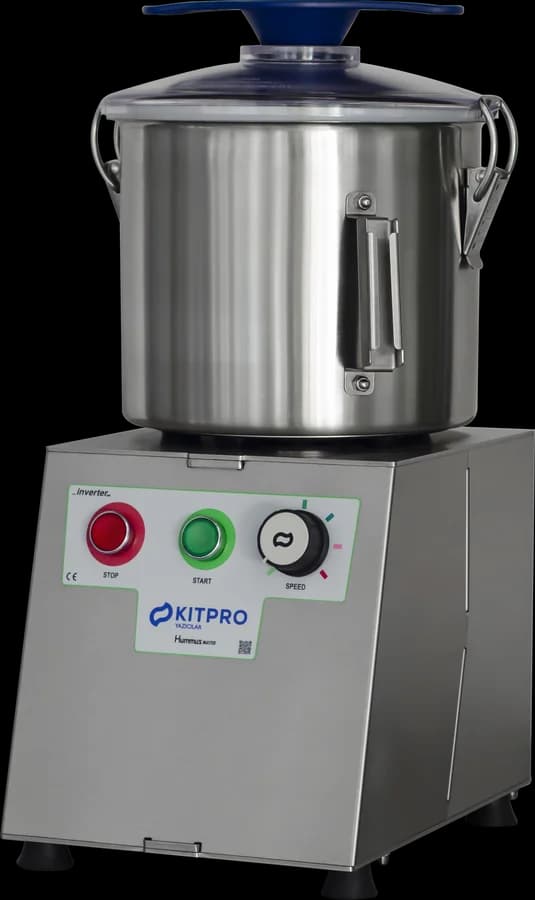
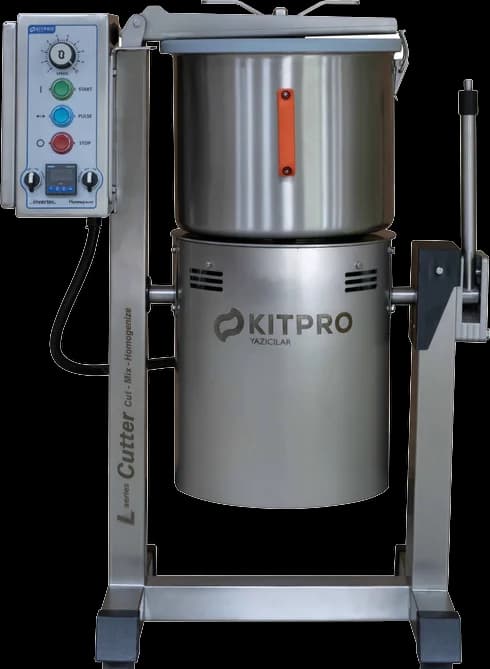
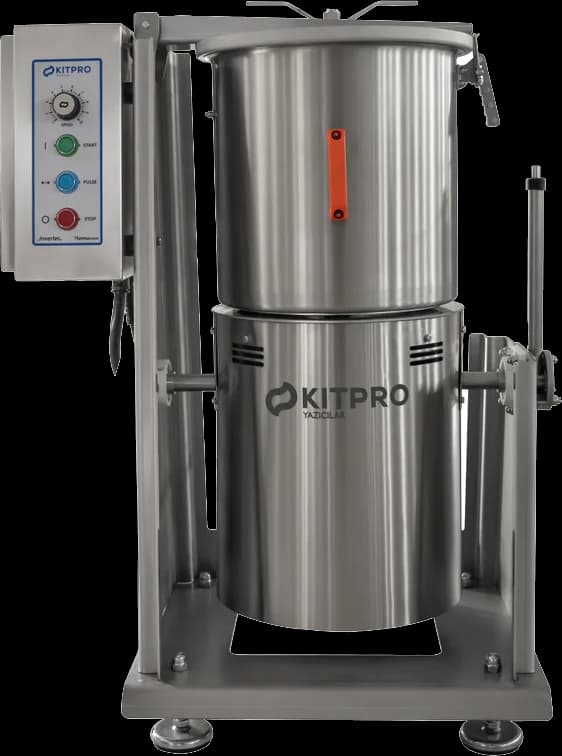
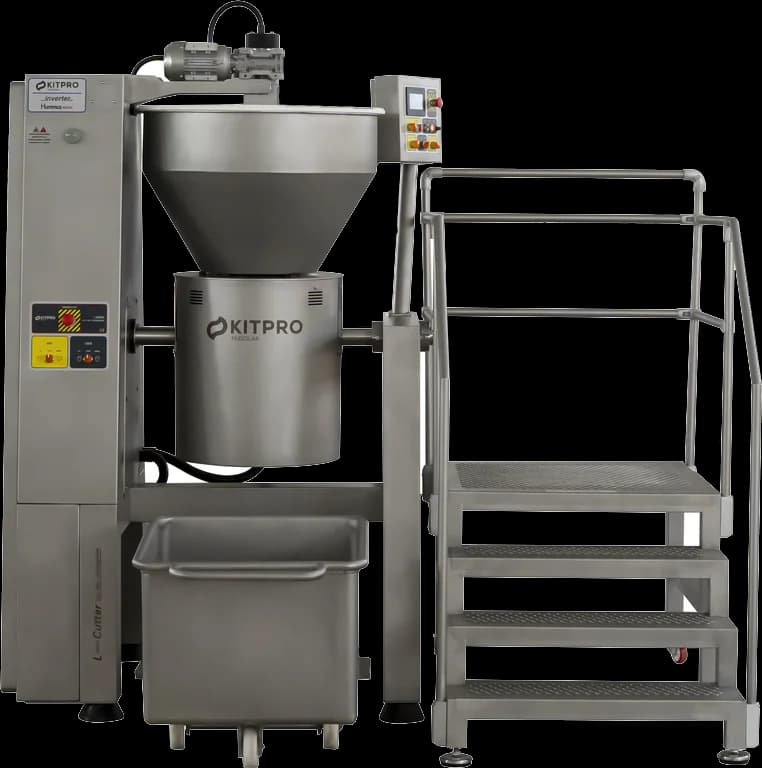
The table below maps the typical results of that calculation onto the KITPRO range. If you land on a boundary, take the larger tier: a bigger machine means fewer batches, and less labour and cleaning time.
| Daily output | Batch volume | Bowl | Typical user | |
|---|---|---|---|---|
| 6-12 L | Up to 100 kg | 4-8 kg | 6 / 9 / 12 L | Restaurant, hotel, catering kitchen |
| 20-30 L | 100-400 kg | 13-20 kg | 20 / 30 L | Boutique producer, central kitchen |
| 45-65 L | 400-1,000 kg | 29-42 kg | 45 / 65 L | Mid-scale food manufacturer |
| 120-200 L | 1,000 kg and above | 78-130 kg | 120 / 200 L | Industrial production line |
Four mistakes that keep repeating
Most sizing errors come not from bad arithmetic but from variables left out of the calculation.
- Ignoring growth: a machine runs 8-10 years. Sized on today's volume it will be tight within three. Size for about 30% above target.
- Forgetting cleaning time: the bowl is washed on every recipe change. With a varied product mix, two smaller machines can beat one large one.
- Skipping the electrical supply: models above 30 litres usually require 400 V three-phase. If the kitchen only has 230 V single-phase, that limits the choice before capacity does.
- Not checking it fits: floor-standing and industrial models have to be moved into place. Measure body width and height in advance.