
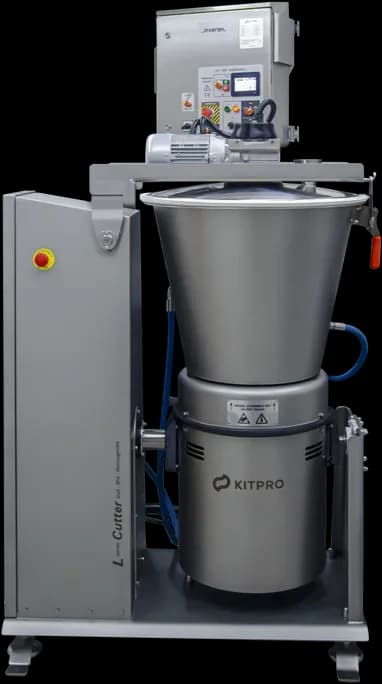
Why temperature matters so much
A large share of the mechanical energy spent in a cutter turns into heat. In a dense mix that heat has nowhere to go, so it raises the temperature of the product directly. In a batch run long at high speed, the mix ends up well above where it started.
That rise has three consequences. The first is microbiological: a product going to chilling while warm stays at risk throughout the cooling period, and shelf life shortens. The second is texture: as tahini oil warms it tends to separate, and the surface looks oily. The third is flavour. Heat is the fastest way to dull the fresh aroma of chickpeas.
The goal in hummus production is therefore not the fastest batch but the batch that raises temperature least.
Speed strategy: smooth texture, low heat
A smooth texture calls for high speed; low temperature calls for low speed. The balance is not struck by holding speed constant but by changing it through the batch.
What works in practice: break down the chickpeas and solids at low speed, bring in tahini and liquids at mid speed, and achieve smoothness with a short burst of high speed at the end. The shorter the total time at high speed, the smaller the temperature rise.
None of this is possible on a fixed-speed machine. For hummus, inverter control is a production requirement rather than a convenience.
- Load ingredients cold: outlet temperature follows inlet temperature directly.
- Do not overfill; in a dense mix the fill ratio should not exceed 65%.
- Keep high speed to the end of the batch and to the shortest time possible.
- Use the scraper: material left on the wall does not rejoin the mix, so the batch runs longer and hotter.
Capacity tiers
Batch times in hummus are longer than for most products, typically 8-12 minutes. Base your capacity calculation on that.
| Daily output | Recommended bowl | Critical feature | |
|---|---|---|---|
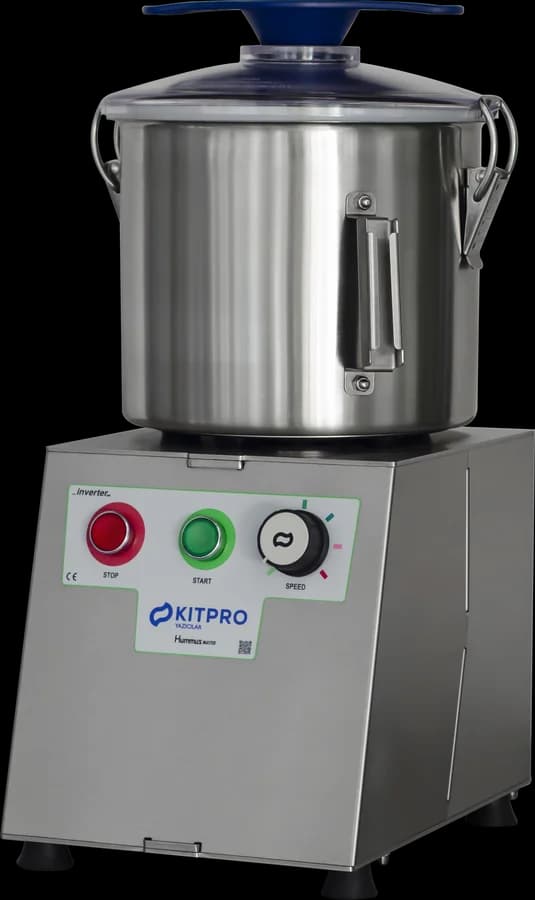
| Restaurant / catering | Up to 100 kg | 6-12 L countertop | Inverter, easy cleaning |
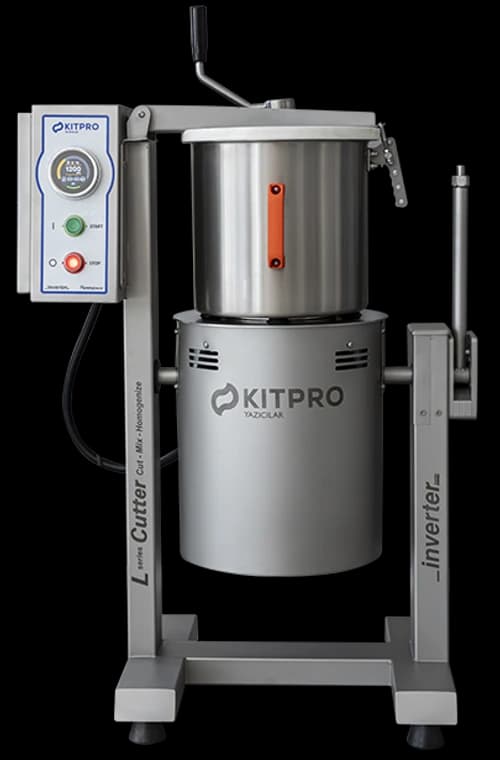
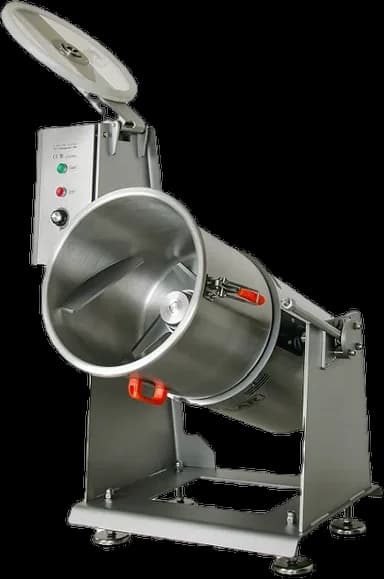
| Boutique producer | 100-400 kg | 20-30 L floor-standing | Inverter, tilting bowl |
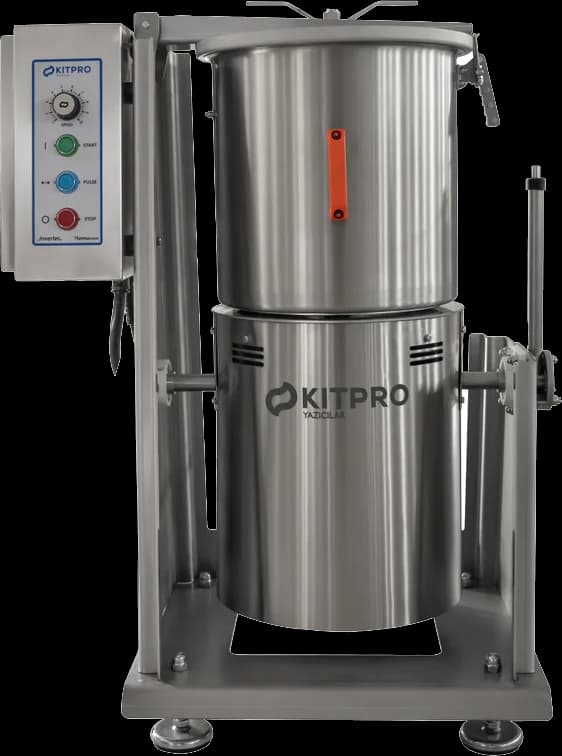
| Mid-scale production | 400-1,000 kg | 45-65 L floor-standing | Inverter, double-acting scraper |
| Industrial line | 1,000 kg and above | 120-200 L industrial | Motorised scraper, powered discharge |
Time and consistency in large batches
In large batches the real goal is to reach the target texture quickly and the same way every time. A powerful drive, the right blade geometry and a scraper that keeps the bowl wall clean are the three things that shorten processing time.
The HummusMaster grew out of exactly this need: with blades shaped for hummus, a motor that does not struggle in a dense chickpea-tahini mix and a double-acting scraper, it turns chickpeas into a smooth cream quickly, and presets repeat the same texture on every batch.